
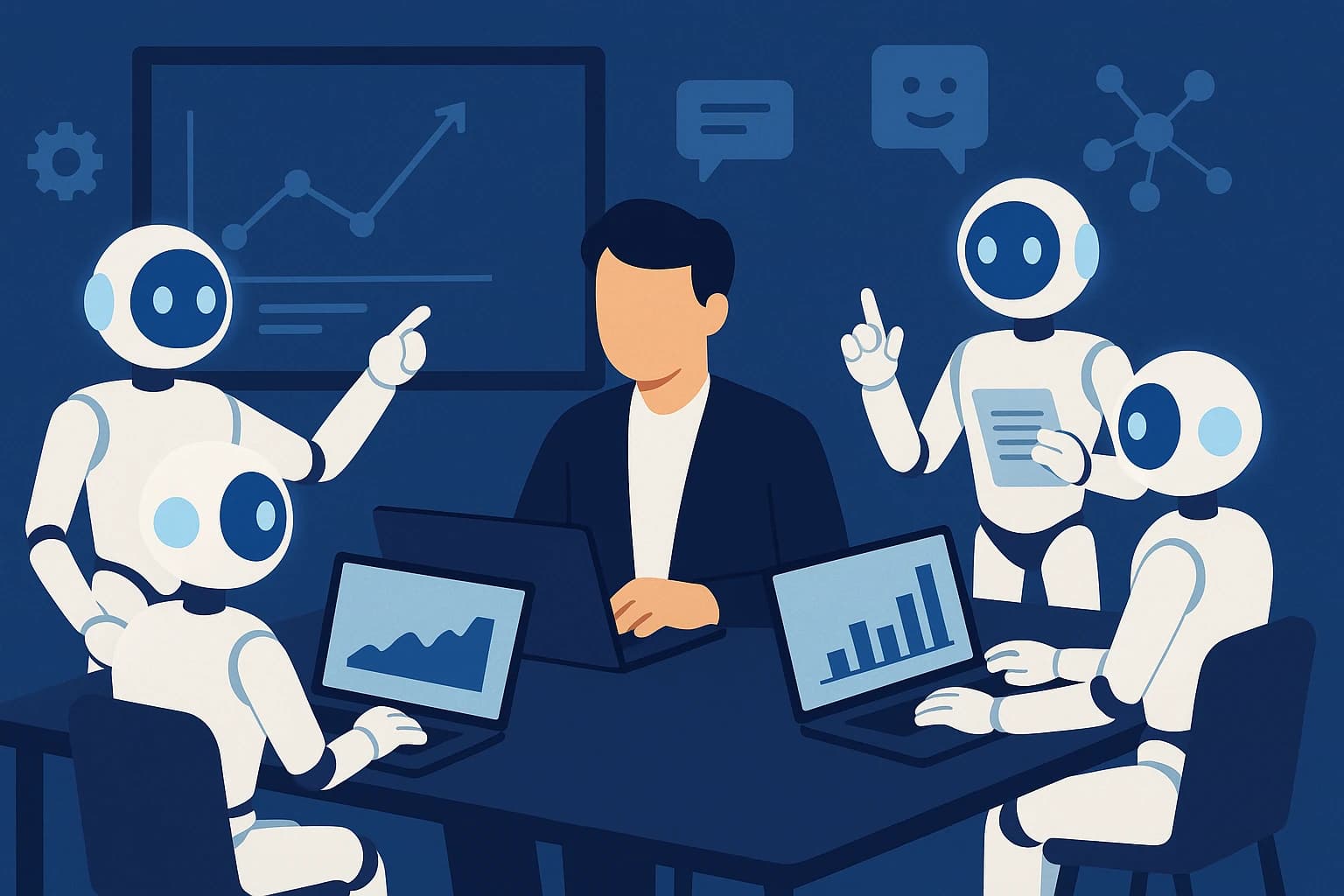
The Rise of the Multi-Agent Team: How AI Agents Will Collaborate to Run Your Business
By Dan Martuszewski
22/12/2025
Your Business Has a New Dream Team, and It's Not Human
Imagine your best project manager, your sharpest market analyst, and your most creative marketer all working together seamlessly, 24/7, without ever needing a coffee break. This isn't science fiction; it's the future of business operations powered by AI.
We're all familiar with how a company is structured. You have a marketing department, a sales team, a finance expert, and so on. Each has a specialized skill. The next wave of AI works the same way. We're moving from single, general-purpose AI tools to sophisticated, collaborative teams of AI agents.
A multi-agent team is a group of specialized AI programs, or 'agents,' designed to work together to achieve a common goal. Each agent has a specific role, just like an employee, and they can communicate and pass tasks to one another automatically.
In this article, we'll explore how these AI teams will revolutionize business, using the practical example of launching a new product to show you exactly how it works and what it means for you.
Meet the Team: Assembling Your AI Workforce
Let's imagine your company is launching a new, innovative coffee mug. Instead of a human team, you assign the task to your multi-agent AI system. Here are the key players on the team:
"Alex," the Research Agent:
- Role: The market analyst. Its job is to gather and synthesize information.
- Tasks: Scans competitor websites, analyzes pricing strategies, reads customer reviews for similar products, and identifies the target audience's pain points and desires.
- Output: A concise report on market opportunities and key messaging angles.
"Casey," the Copywriting Agent:
- Role: The creative wordsmith. Its job is to craft compelling text.
- Tasks: Takes the research report from Alex. Writes product descriptions, website copy, email announcement drafts, and ad headlines that resonate with the identified target audience.
- Output: A portfolio of ready-to-use marketing copy.
"Sam," the Social Media Agent:
- Role: The social media manager. Its job is to create buzz.
- Tasks: Receives the copy from Casey. Generates social media posts for different platforms (LinkedIn, Twitter, Instagram), suggests relevant hashtags, and even creates simple visual concepts or prompts for a design AI. It can also schedule the posts for optimal engagement times.
- Output: A complete, ready-to-deploy social media campaign calendar.
"Riley," the Sales Outreach Agent:
- Role: The sales development representative. Its job is to find and engage potential customers.
- Tasks: Uses the target audience profile from Alex and the email copy from Casey to identify potential B2B clients or influencers. It then drafts and sends personalized outreach emails.
- Output: A list of engaged leads and scheduled meetings.
The AI Workflow in Action: Launching the Product
Here's how this dream team comes together to get the job done.
Step 1: The Manager's Brief The process starts with a single instruction from a human manager: "Launch the new smart coffee mug. The target audience is tech-savvy professionals. The budget is X. The deadline is Y."
Step 2: Alex Gets to Work The system's 'Project Manager' agent assigns the first task. Alex (Research Agent) immediately begins its analysis, pulling data from live sources. Within an hour, it delivers a market summary.
Step 3: The Handoff to Casey The project manager agent automatically verifies Alex's report is complete and passes it to Casey (Copywriting Agent). Casey analyzes the key messaging points and begins drafting all necessary copy, adapting the tone for different channels.
Step 4: Parallel Processing - Sam and Riley Engage Once the copy is ready, the system works in parallel. Sam (Social Media Agent) takes the approved copy and builds out the social campaign. Simultaneously, Riley (Sales Agent) uses the same core messaging to start its outreach sequence.
Step 5: The Human in the Loop At a pre-defined checkpoint, the entire plan (market summary, copy, social calendar, outreach list) is presented to the human manager for a final 'go-ahead.' The manager's role shifts from doing the work to directing and approving the strategy.
Step 6: Execution and Reporting Once approved, Sam starts posting, and Riley starts sending emails. The system then monitors key metrics (engagement rates, email replies) and compiles them into a simple, real-time dashboard for the manager.
Why This Changes Everything: The Business Benefits of AI Teams
This collaborative approach isn't just a novelty; it delivers tangible business value.
- Unprecedented Speed and Efficiency: The entire launch process that might take a human team weeks of meetings, emails, and revisions can be executed in a matter of hours. The handoffs are instant and error-free.
- Massive Scalability: Want to launch five products instead of one? Or launch the same product in ten different languages? An AI team can scale its operations instantly without the need to hire and train new people.
- Enhanced Creativity and Strategy: By automating the repetitive, time-consuming tasks, you free up your human team to focus on what they do best: high-level strategy, creative thinking, and building customer relationships. The AI team handles the 'how,' so your people can focus on the 'why' and 'what's next'.
- 24/7 Operations: Your AI team doesn't sleep. It can run market analysis overnight, respond to customer inquiries in different time zones, and ensure your business is always moving forward.
Preparing for Tomorrow: How to Get Ready for Multi-Agent AI
You don't need to be a technical expert to prepare for this future. The key is to start thinking differently about how work gets done.
- Start Thinking in Processes: Begin by mapping out your core business workflows. Where are the bottlenecks? Where do handoffs between teams happen? Understanding your current processes is the first step to identifying where an AI team could help.
- Identify High-Value, Repetitive Tasks: Look for tasks that are rule-based and data-heavy. These are often the best starting points for automation with single agents, which is the stepping stone to multi-agent systems.
- Foster a Culture of Experimentation: Encourage your team to start using today's AI tools. The more comfortable they become with AI as a partner, the easier the transition will be to more advanced systems.
- Partner with Experts: The world of AI is moving incredibly fast. Working with a knowledgeable partner can help you navigate the landscape, understand what's possible, and build a strategy that's right for your business.
Conclusion: The Future is Collaborative
The shift from single AI tools to collaborative multi-agent teams is more than just a technological upgrade; it's a fundamental change in how a business can operate. It's about building a digital workforce that complements your human talent, unlocking new levels of speed, scale, and strategic focus.
Just as you wouldn't ask your accountant to design a marketing campaign, the future of AI is in specialization and collaboration. By assembling a team of expert AI agents, you can automate complex functions from end to end.
The question for business leaders is no longer if these AI teams will become a part of their operations, but when and how. The companies that start preparing today will be the ones that lead tomorrow.