
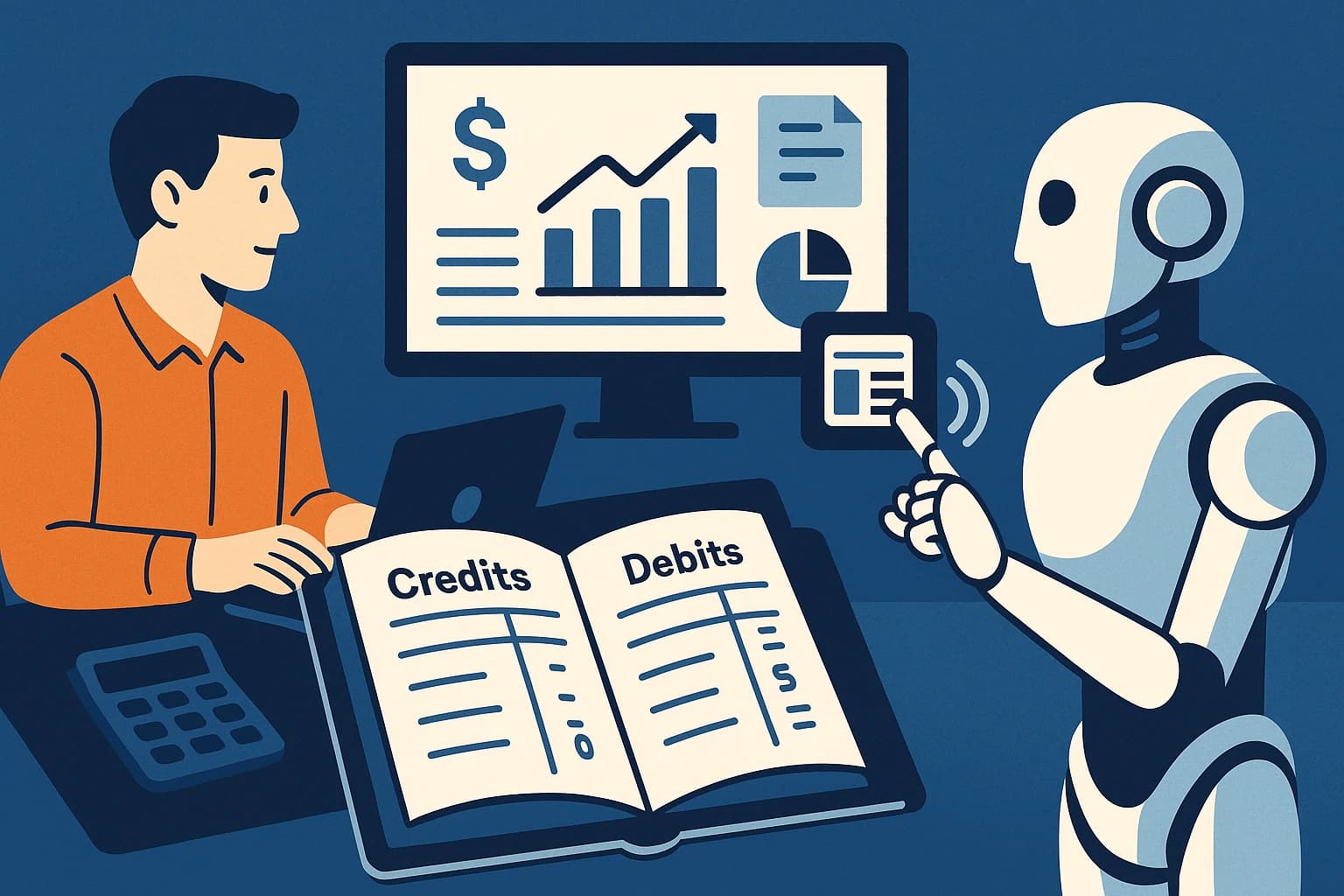
The End of Manual Bookkeeping? Automating Financial Reporting with AI Agents
By Agnes Martuszewska
10/11/2025
The Familiar Grind of Financial Admin
It’s the last week of the month, and the familiar dread sets in. The office is quiet, but for you or your finance manager, the day is far from over. You’re buried in spreadsheets, surrounded by coffee cups, chasing down numbers from a dozen different sources. The goal? To piece together a Profit & Loss statement that accurately reflects the last 30 days. You're manually matching bank statements to invoices, hunting for that one misplaced decimal point that’s throwing everything off, all while knowing that by the time you're done, the data will already be a week old.
This is the reality for countless businesses. Manual bookkeeping and financial reporting are massive time-sinks, prone to human error, and they delay access to the very insights you need to make critical decisions. It’s a reactive cycle of catching up, rather than proactively steering the ship.
But what if you could reclaim those hours and get perfectly accurate financial reports, automatically, every week? This isn't a futuristic dream; it's the reality being delivered by AI agents. This article will explain how these intelligent assistants are revolutionizing financial administration, freeing up your team to focus on strategy and growth instead of manual data entry.
What Exactly is an AI Agent for Finance? (The Simple Explanation)
Forget complex jargon like "large language models" or "APIs." Think of an AI agent as a dedicated, super-efficient digital employee for your finance department.
Imagine hiring a junior accountant who works 24/7, never gets tired, never makes a copy-paste error, and has instant, secure access to all your financial data. That's your AI agent.
It works by securely connecting to the tools you already use - your accounting software like QuickBooks or Xero, your business bank accounts, and your invoicing platforms. The agent acts as an intelligent bridge between these systems, pulling data from all of them to perform tasks you've assigned, completely on its own. The goal isn't to replace your accounting software, but to put it on autopilot and make it infinitely smarter.
Three Game-Changing Tasks Your AI Agent Can Handle Today
Here’s where the theory becomes reality. Let's look at three common financial tasks and compare the old, manual way with the new, automated approach.
1. Automated Weekly Reporting (P&L and Cash Flow)
- The Old Way: You spend hours every month manually exporting data from your accounting software, pasting it into a spreadsheet template, double-checking formulas, and finally emailing the report to leadership - often days after the period has closed.
- The New Way (with AI): Every Monday morning, like clockwork, the AI agent automatically pulls the latest data from your systems. It generates a clean, easy-to-read Profit & Loss (P&L) and Cash Flow statement and delivers it directly to your inbox or a dedicated Slack channel.
- Benefit Spotlight: You get a consistent, real-time pulse on your business's financial health without lifting a finger, enabling you to spot trends as they happen, not weeks later.
2. Intelligent Variance Analysis
- The Old Way: A senior team member spends hours meticulously comparing the actual numbers in the P&L to the budget spreadsheet. They hunt through transactions to figure out why marketing spend was 20% over or sales were 10% under budget. It's detective work, and it's slow.
- The New Way (with AI): The AI agent instantly compares actuals to your budget. It doesn't just flag the differences; it provides a simple, plain-English summary explaining why the variance occurred. For example: "Marketing spend exceeded budget by $5,000 due to the new ad campaign launched on Facebook this month."
- Benefit Spotlight: You move from asking "what happened?" to understanding "why it happened" in seconds, enabling faster, more informed strategic adjustments.
3. Seamless Reconciliation
- The Old Way: The dreaded month-end task. Someone sits down with the bank statement on one screen and the accounting system on the other, manually matching every single line item to an invoice, receipt, or payment. It's a tedious, detail-oriented process that can take days and is ripe for error.
- The New Way (with AI): The AI agent works quietly in the background, 24/7. It constantly matches incoming bank transactions with invoices and expenses in your accounting software in real-time. It handles 95% of the work automatically and simply flags the few discrepancies that require a human review.
- Benefit Spotlight: You can close your books in a fraction of the time, maintain a consistently accurate financial record, and dramatically reduce the risk of costly accounting errors.
Seeing it in Action: The Nominal Example
This isn't just theory; companies are already building powerful tools to do this. A great real-world example is the platform offered by Nominal. Their AI is designed specifically to automate complex accounting workflows for businesses. They help companies automate everything from creating multi-step journal entries to generating detailed variance explanations, turning what used to be weeks of manual work into a matter of minutes. This proves that the technology is mature, reliable, and already delivering a massive return on investment to businesses today.
The True Business Impact: More Than Just Saved Time
Adopting a financial AI agent delivers benefits that ripple across the entire organization.
- Massive Time Savings: Imagine saving 20, 40, or even 60 hours of manual financial administration every single month. What could you or your team accomplish with that time back?
- Drastic Error Reduction: An AI agent doesn't get tired or make typos. By automating data entry and reconciliation, you achieve a higher quality of financial data, which builds trust and confidence in your numbers.
- Accelerated Decision-Making: With up-to-date reports and instant analysis delivered automatically, leadership can make smarter decisions about budgeting, hiring, and strategy based on current reality, not last month's old data.
- Improved Employee Morale: Nobody enjoys tedious, repetitive work. By automating the grunt work, you free your skilled finance professionals to focus on higher-value strategic analysis, forecasting, and advisory tasks they actually find engaging.
Your First Step Towards Automated Finance
The days of manual bookkeeping are numbered. It's inefficient, error-prone, and keeps your most valuable asset - your people - tied up in low-value tasks. AI agents offer a powerful, accessible way to automate financial reporting, reduce errors, and gain a significant competitive edge.
The question is no longer if businesses will adopt this technology, but when. The shift is from reactive data entry to proactive financial strategy. By automating the foundational tasks, you empower your team to look forward, not backward.
Ready to see how an AI agent could transform your financial operations?