
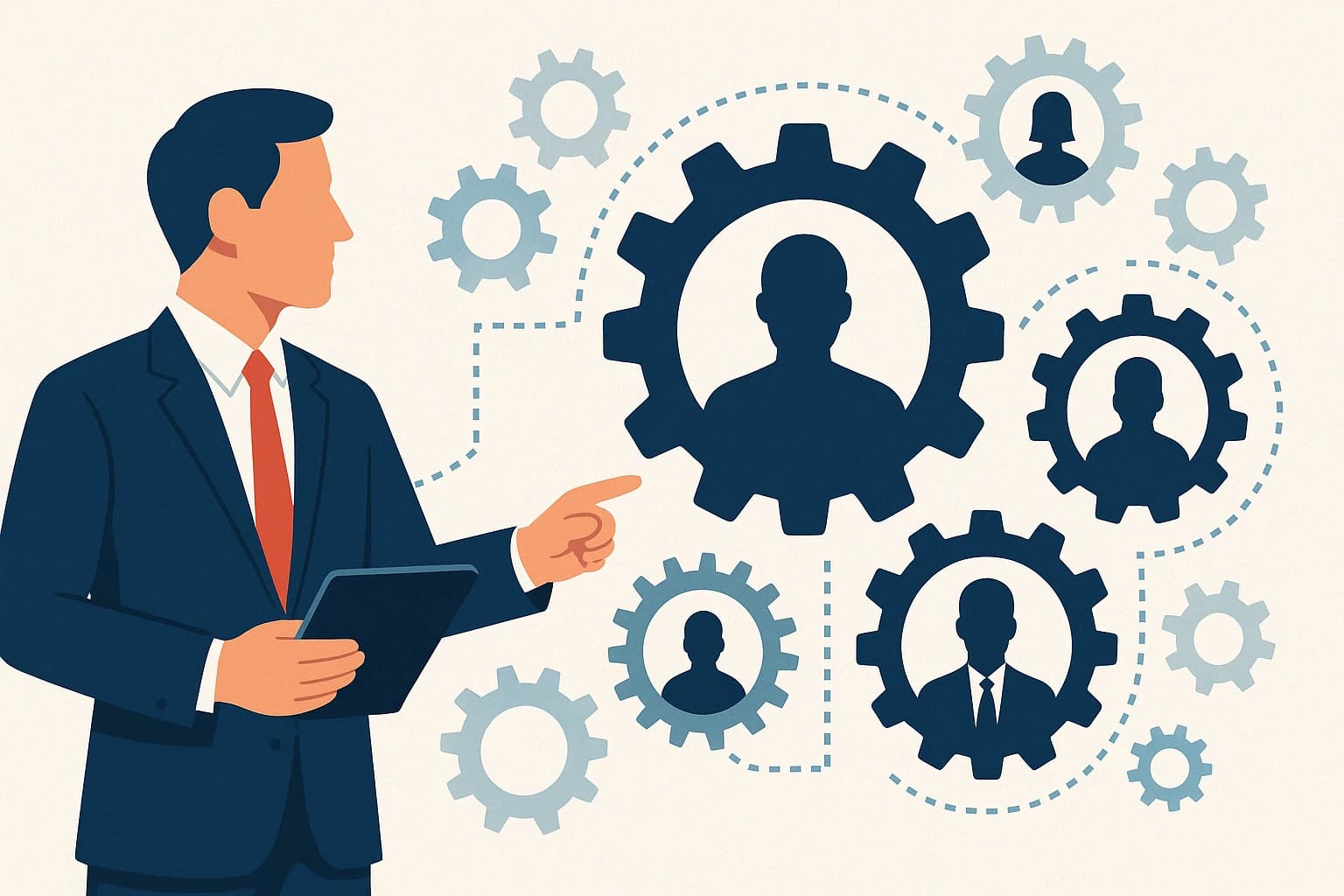
The Augmented Leader: How to Shift Your Focus from Managing People to Managing Processes
By Dan Martuszewski
08/01/2026
It's 7 PM. The office is quiet, but your mind is still racing. You spent today approving invoices, chasing project updates, and sitting in on operational meetings that could have been an email. You know you need to think about next quarter's growth strategy, the new market you want to explore, or the company culture you want to build. But you're too exhausted from managing the “now.”
Does this sound familiar?
If it does, you’re not alone. Many leaders find themselves as the primary bottleneck in their own companies, trapped in a relentless cycle of managing day-to-day operations and employee tasks. This isn't a failure of leadership; it's a symptom of an outdated operational model that relies on the leader as the central processing unit for every decision and action.
But what if you could fundamentally change the nature of your role? This is where automation and AI come in, not as complex tech projects, but as a gateway to a new philosophy of leadership. The goal is to evolve from managing people to designing and managing processes. This article will explore how embracing automation allows you to reclaim your most valuable asset - time - and shift your focus from operational firefighting to high-impact strategic leadership.
The Old Way vs. The New Way: People Manager vs. Process Architect
The shift powered by automation is profound. It changes not just what you do, but how you think about your role as a leader. Let's compare the two models.
The Traditional Leader: The People Manager
As a People Manager, your focus is on direct oversight. You are the orchestra conductor, needing to cue every single musician to play their part. You assign tasks, conduct constant check-ins, and serve as the central hub for questions and approvals. Your days are filled with answering repetitive questions, manually pulling reports to understand what's happening, and approving every small decision. The music stops the moment you step away from the podium.
The Augmented Leader: The Process Architect
As a Process Architect, your focus is on designing the system, not running it. You are the architect of the concert hall, meticulously designing a space with perfect acoustics where the orchestra can perform flawlessly, even without your moment-to-moment guidance. Your key activities involve defining clear objectives for your automated systems, analyzing performance dashboards, and identifying bottlenecks in the process, not the people.
Consider a common business function like sales reporting. The People Manager spends hours each week chasing sales reps to update the CRM, then manually compiles the data into a report for the board meeting. The Process Architect designs a system where an AI agent automatically logs calls, transcribes notes, updates the CRM in real-time, and generates a live dashboard that's always accurate. The leader's focus shifts from chasing data to analyzing it.
The Gift of Time: What Do You Do With Your Newfound Focus?
When you’re no longer buried in the daily grind, you create the space to do the work you’ve always wanted to do - the work that truly grows the business. This is what it looks like in practice.
Refining the Business Model
With your head above the operational weeds, you can see the bigger picture. You finally have the mental bandwidth to question and improve the very foundation of your business. You can ask the big questions: Are our pricing tiers still relevant? Could we pivot to a more profitable subscription service? Is there a more efficient way to deliver value to our top customers?
Exploring New Markets and Opportunities
Your focus can shift from defending your current market share to actively seeking new horizons. You'll have the time to investigate international expansion, explore how your product could serve an adjacent industry, or even brainstorm entirely new service lines based on the clean, reliable data your automated systems are gathering.
Building Strategic Partnerships
Relationships are the currency of business, but they take time to build - time you now have. You can attend industry conferences to actually network, not just clear your inbox in the hallway. You can have long, strategic lunches with potential partners and co-develop new initiatives with complementary businesses that create exponential value.
Cultivating an Unbeatable Company Culture
Company culture isn't built in status meetings; it's built through intention, mentorship, and presence. With your time freed up, you can invest it in your people. You can spend more one-on-one time mentoring high-potential employees, develop meaningful professional development programs, and be the visible, present champion of the company's vision and values.
Automation as Your Strategic Co-pilot
It’s crucial to reframe how you see AI agents. They aren’t just simple tools for completing tasks. They are strategic assets that serve as your co-pilot.
Well-designed AI agents don't just do the work; they generate clean, real-time data and reports as a natural byproduct of their operation. This allows you to move from making decisions based on "gut feel" and outdated reports to steering the company with data-driven precision. You’re no longer guessing about your sales pipeline or your operational efficiency; you're looking at a live, accurate dashboard.
This creates a powerful feedback loop. As a Process Architect, you can make a small tweak to the system - change a rule in an AI agent or adjust a workflow - and see immediate, measurable results across the entire operation. This is infinitely more powerful and scalable than trying to individually retrain dozens of people on a new procedure.
Lead Your Business, Don't Just Run It
The ultimate goal of automation is to augment your intelligence and impact, not just the company's output. It transforms your role from a hands-on manager, mired in the day-to-day, to a visionary architect, focused on the future.
Your job as a leader is to make a few great decisions each year. Automation frees you from the thousands of small, repetitive decisions so you can focus your energy, creativity, and expertise on the big ones that truly matter.